





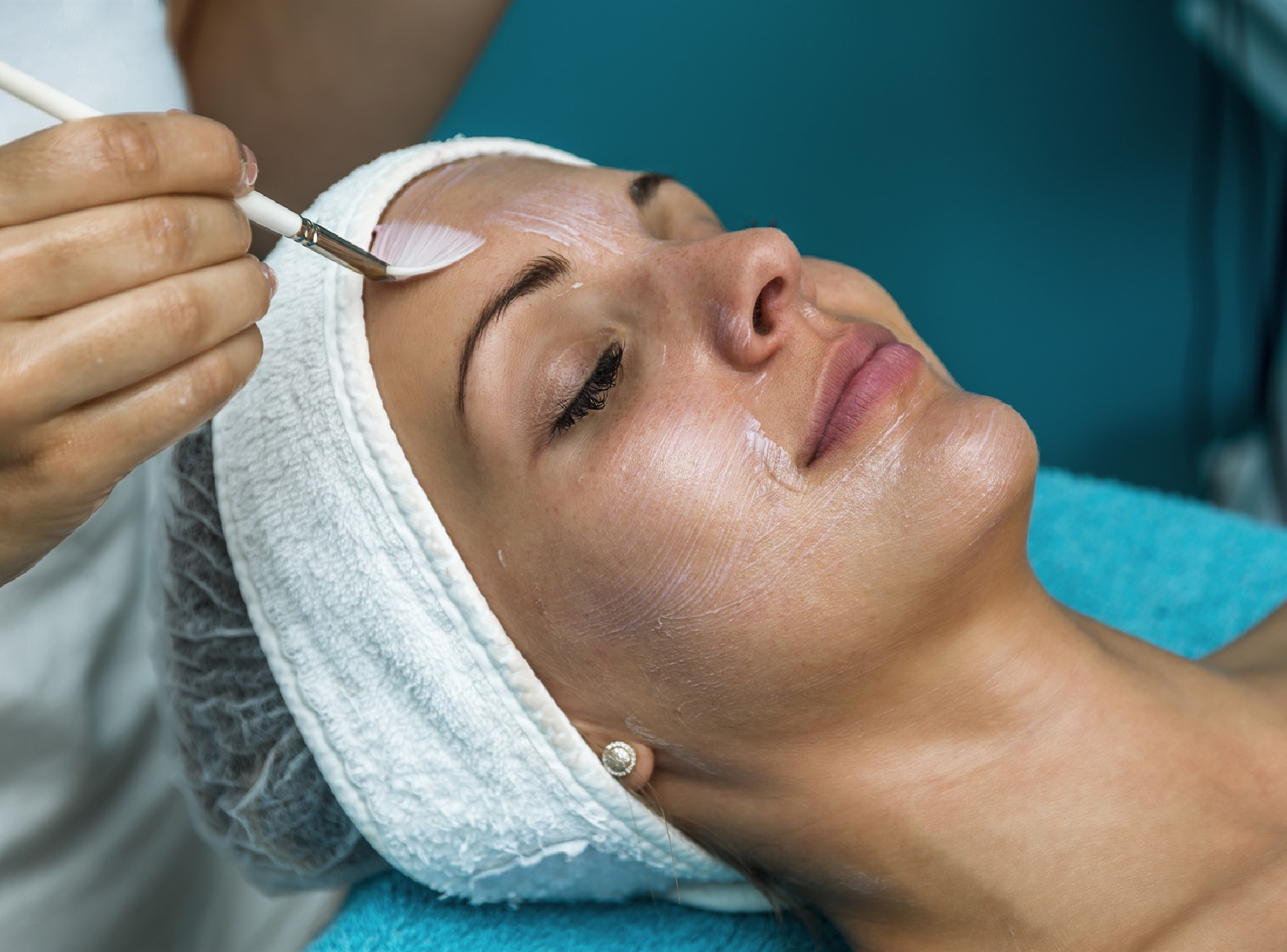
Compared to face scrubs, facial peel treatments exfoliate deeper while addressing the underlying causes of your skincare issues. Their efficacy is constantly being improved by new formulations, and they are typically kinder than abrasive scrubs.
At Perfect Doctors Clinic, we offer a range of advanced face peel options, and have asked our top skincare expert to explain who will benefit most from each procedure we offer.
Chemical Peel Treatment In Dubai
Chemical Peel Treatment in Dubai is a non-surgical aesthetic procedure designed to improve skin texture, tone, and overall appearance by removing damaged outer layers of skin. It is commonly used to treat acne, pigmentation, sun damage, fine lines, and dull skin. The treatment is performed using medical-grade peeling solutions and is tailored to different skin types for safe, effective, and long-lasting skin rejuvenation results.
People With Acne-Prone Or Oily Skin Issues
If you suffer from problems with greasy skin and pimples caused by acne, you need a peel that uses fairly light ingredients and requires minimal downtime. These peels facilitate exfoliation by dissolving the bonds that hold your dead skin cells together. Antioxidants and vitamins are delivered by active ingredients that penetrate deeply into the skin and support the health and strength of newly formed cells.
Top 3 peels for you:
- Nimue’s remedial therapy
- Oxygenating thermal detox
- Treatment with Nimue TCA
Minor Issues With Pigmentation, Sun Damage And Fine Lines
More medium-depth peels are needed for these problems. They are a little more uncomfortable compared to lighter peels and may cause minor side effects like redness and swelling. The extra layers you shed will guarantee that the new skin appears from underneath, with a smooth texture and even tone, but you will need some downtime with these.
Top 3 peels for you:
- Treatment with Nimue TCA
- Nimue peel with glycolic acid
- Treatment for Nimue fading
People With Scarring, Severe Sun Damage And/Or Deep Wrinkles
These issues require the strongest type of facial peel. The procedure will require you to be sedated, and you should anticipate having extremely red, possibly scabby skin that will require two months of healing time in addition to a week or so of recuperation. You will require a full-face procedure, because hyperpigmentation cannot be treated in small areas, but you will get dramatic results.
- Treatment for Nimue fading
- Nimue peel with glycolic acid
- Nimue’s remedial therapy
If you’re having any of the problems described above and would like to try one of our superb chemical peel treatments, call us now to book a free consultation during the discount season with our skincare specialist.
Our beautiful spa is conveniently situated in Dubai.
What Conditions Does A Chemical Peel Treat?
Chemical peels are employed to address specific skin conditions or to enhance your appearance by refining the skin’s tone and texture.
Chemical peels are predominantly conducted on the face, neck, or hands. They can assist in mitigating or enhancing:
- Fine lines beneath the eyes or around the mouth, along with wrinkles resulting from sun exposure, aging, and hereditary influences.
- Certain categories of acne.
- Minimal scarring.
- Sun spots, age spots, liver spots, freckles, and irregular skin pigmentation.
- Precancerous scaly lesions known as actinic keratosis.
- Rough skin, xerotic patches, and a lackluster complexion.
- Darkened patches (melasma) resulting from pregnancy or the use of oral contraceptives.
You will collaborate with your dermatologist to establish the appropriate depth of your chemical peel. This collective decision may differ based on the condition of your skin and the goals of the treatment.
Sagging skin, prominent bulges, deep scars, pronounced facial lines, and more advanced wrinkles are less responsive to chemical peels. If these are your concerns, alternative cosmetic surgical procedures such as carbon dioxide laser resurfacing, a facelift, brow lift, eye lift, or soft tissue fillers may offer more suitable options. A dermatologic surgeon can assist in identifying the most appropriate treatment for your concerns.
Is a Chemical Peel Good For All Skin Types?
Generally, superficial chemical peels are suitable for all skin types. However, individuals with darker skin tones face a higher risk of skin darkening following treatment. This condition is known as post-inflammatory hyperpigmentation. If you possess a naturally darker skin tone, it is advisable to consult your dermatologist regarding alternative, less aggressive treatments to minimize the risk of hyperpigmentation.
Chemical peeling may also be contraindicated if you:
- Possess a history of atypical skin scarring.
- Possess additional pigmentation within your scars.
- Possess skin conditions or be on medications that increase skin sensitivity.
- It is not advisable to remain outdoors in the sun during the healing period.
BOOK AN APPOINTMENT TODAY
How Are Chemical Peels Performed?
A chemical peel may be conducted in a physician’s office or a surgical facility as an outpatient procedure. Your skin will be meticulously cleansed with a solution that eliminates excess oils, while your eyes and hair are safeguarded. A chemical solution is subsequently applied to your skin. Chemical solutions commonly employed include glycolic acid, trichloroacetic acid, salicylic acid, lactic acid, and phenol (also known as carbolic acid). The various types of chemicals induce a controlled injury, each penetrating to a distinct depth within the skin, subsequently peeling away to expose a new layer of skin.
The various chemical solutions yield different outcomes. The selection of the chemical is determined by your specific objective. You will collaborate with your dermatologist to establish the appropriate depth of your chemical peel.
- A mild (referred to as “lunchtime”) chemical peel offers gradual enhancement and is frequently performed in a series. The outermost layer of the skin is exfoliated. This option may be most suitable if you have fine lines, acne, uneven skin tone, or dry, rough, sun-damaged skin, as it aids in promoting a healthy radiance. Recovery from this type of peel may occur within hours to several days, with minimal to no downtime.
- A medium chemical peel imparts a smooth and rejuvenated appearance to the skin. The outermost layer and the upper portion of your middle skin layer are excised. This option may be most suitable if you have uneven or moderate skin discoloration, age spots, acne scars, or fine to moderate wrinkles. Recovery from this type of peel may require one week or longer and may necessitate a period of rest.
- A deep chemical peel yields the most significant and transformative results. This chemical permeates into the intermediate lower layer of your skin. The recovery period is extended following a deep peel. This option may be most appropriate if you have moderate lines and wrinkles, significant sun-damaged skin, deep acne scars, uneven skin tone, and/or precancerous lesions known as actinic keratosis. A comprehensive chemical peel necessitates pretreatment for a duration of up to eight weeks. Your physician will supply detailed instructions. A deep chemical peel constitutes a single treatment when applied to the face and involves a substantial recovery period.
To prepare for your chemical peel, the following general instructions should be observed:
- Refrain from tanning and direct sunlight exposure for two weeks before each treatment.
- Apply topical agents (such as hydroquinone) according to instructions prior to treatment to condition your skin.
- Refrain from using any products containing retinoids (such as tretinoin) for one to two weeks prior to treatment, unless advised otherwise by your physician.
- If you have been prescribed oral antibiotics or an oral antiviral medication, commence its use at least 1 day prior to your chemical peel.
- Peel areas must be devoid of any open wounds, lesions, or skin infections.
Your physician will provide you with detailed instructions tailored to your specific peel type and individual skin condition.
Day of peel: Your skin will undergo a comprehensive cleansing. If you are undergoing a deep chemical peel, you will be administered general anesthesia (you will be unconscious).
The procedure: During a chemical peel, a solution is applied to the skin. You may experience a warm to moderately hot sensation that persists for several minutes. This is subsequently accompanied by a sharp, tingling sensation. To alleviate the discomfort, a cool compress may be applied to your skin. The chemical is subsequently rinsed and/or neutralized.
What Are The Possible Complications Of Chemical Peels?
In specific skin types, there exists a potential for temporary or long-lasting alterations in skin pigmentation. Using birth control pills, pregnancy, or having a family history of brownish facial discoloration may elevate the risk of developing abnormal pigmentation.
There is also a minimal risk of scarring in specific regions of the face, and some individuals may have a higher susceptibility to developing scars. If scarring occurs, it can generally be managed effectively with appropriate treatment.
If you have a history of herpes outbreaks, there is a slight risk of reactivating the cold sore. Your dermatologist may prescribe medication to decrease the likelihood of a flare-up. Adhere to your physician’s instructions.
Prior to undergoing your chemical peel, it is important to inform your dermatologist if you have a history of keloids (excessive scar tissue formation at the site of skin injury), any atypical scarring tendencies, any previous facial X-rays, or a history of cold sores.
Infections are uncommon but remain a potential risk.
MEET THE EXPERT DOCTOR
Best Aesthetic Clinic In Dubai For Chemical Peel Treatment
Best Aesthetic Clinic in Dubai for chemical peel treatment offers advanced skin rejuvenation solutions tailored to individual skin concerns and goals. Perfect Doctors Clinic in Dubai stands out for its medically supervised chemical peel treatments performed by experienced aesthetic doctors. The clinic offers customized peels for acne, pigmentation, uneven tone, and aging skin using safe, clinically approved techniques. With attractive treatment offers, modern technology, and expert care, patients can achieve clearer, brighter, and healthier-looking skin.